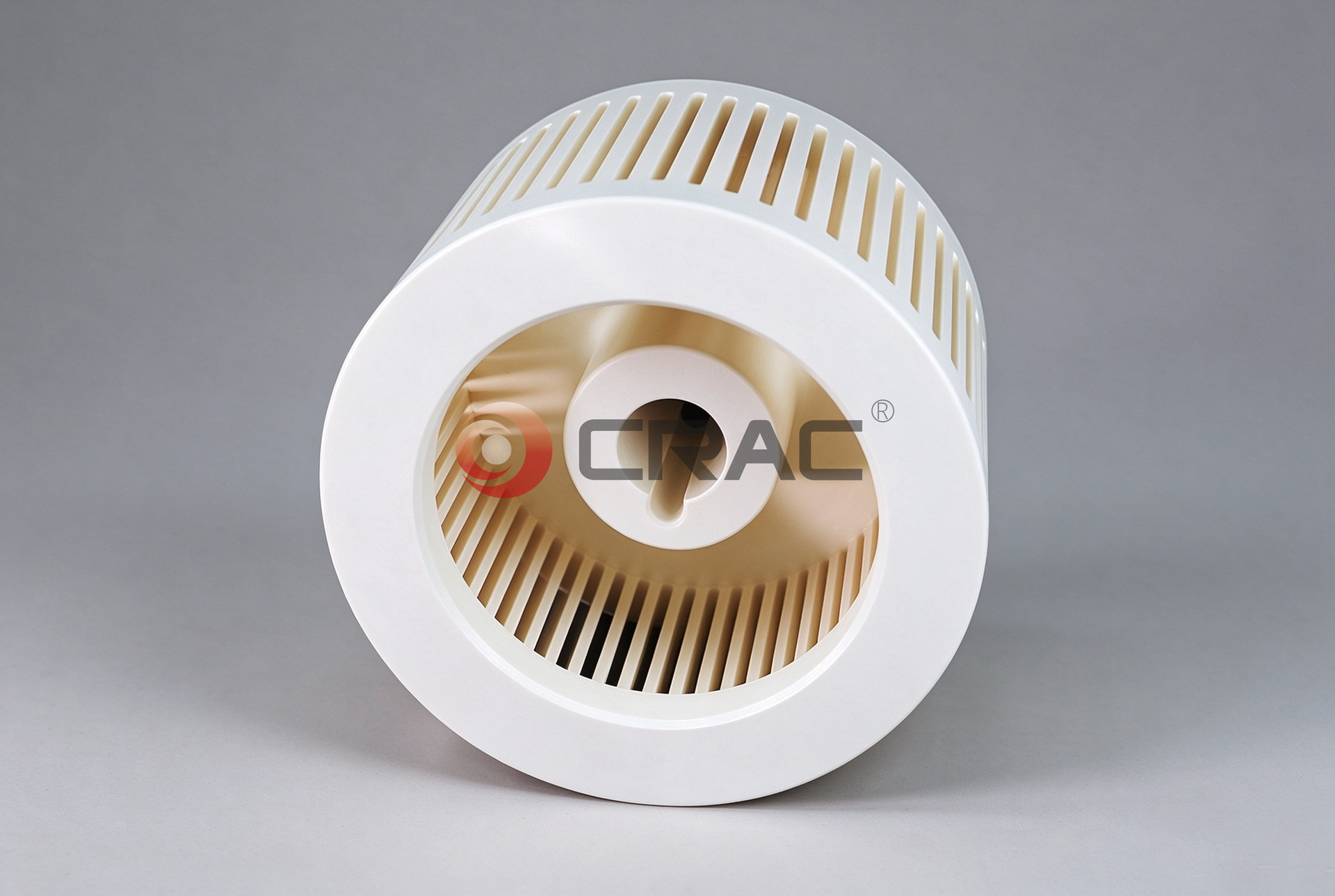
A ceramic classifier wheel is the part of an air classifier that decides the cut point. Inside the classifier, fine powder is carried upward by air while the wheel spins; coarse particles are flung back to the mill by centrifugal force, and only particles small enough to slip through the blade gaps escape as product. The separation size is therefore fixed by the wheel's geometry and speed, not by a filter mesh — which means the wheel has to hold its blade shape to micron tolerance over millions of revolutions or the cut drifts. CRAC builds these wheels in zirconia so the blades keep their edge and add no metal to the powder. See the range on the CRAC ceramic classifier wheels product page.
What Sets the Cut Point
Each particle at the wheel experiences two competing forces: the inward drag of the air stream and the outward centrifugal force from rotation. The particle size where those balance is the cut point. Three geometric variables move it: the blade-gap width (how easily a particle passes), the wheel diameter (larger radius means more centrifugal force at a given speed) and the rotational speed. Tight, consistently shaped blade gaps give a sharp cut and a narrow product size distribution; ragged or worn blades let oversize particles through and broaden the spread.
Why Blades Wear and Why It Matters
In abrasive powders the blade edges are constantly bombarded, and on a metal wheel they slowly erode. Two problems follow: the gaps widen, so the cut point coarsens and drifts; and the worn metal sheds into the product. A zirconia wheel resists that edge wear, so the cut point stays put and the powder stays metal-free. The same stability is the reason a ceramic grading wheel is used in related classification duties.
Materials by Edge and Duty
The grade is chosen for blade-edge durability and the powder being handled. Family-level behaviour:
| Property |
Alumina |
Zirconia (Y-TZP) |
ZTA blend |
| Blade-edge wear | Good | Very good | Good |
| Cut-point stability | Good | Excellent | Good |
| Bending strength | ≥600 MPa | ≥1000 MPa | ≥800 MPa |
| Contamination | None | None | None |
| Best at | Cost-sensitive duty | Abrasive powders, stable cut | Balanced wear + cost |
Grade choice is driven by abrasiveness and the need for a stable cut; our zirconia selection guide compares the options.
Molding Thin-Wall Blades Net-Shape
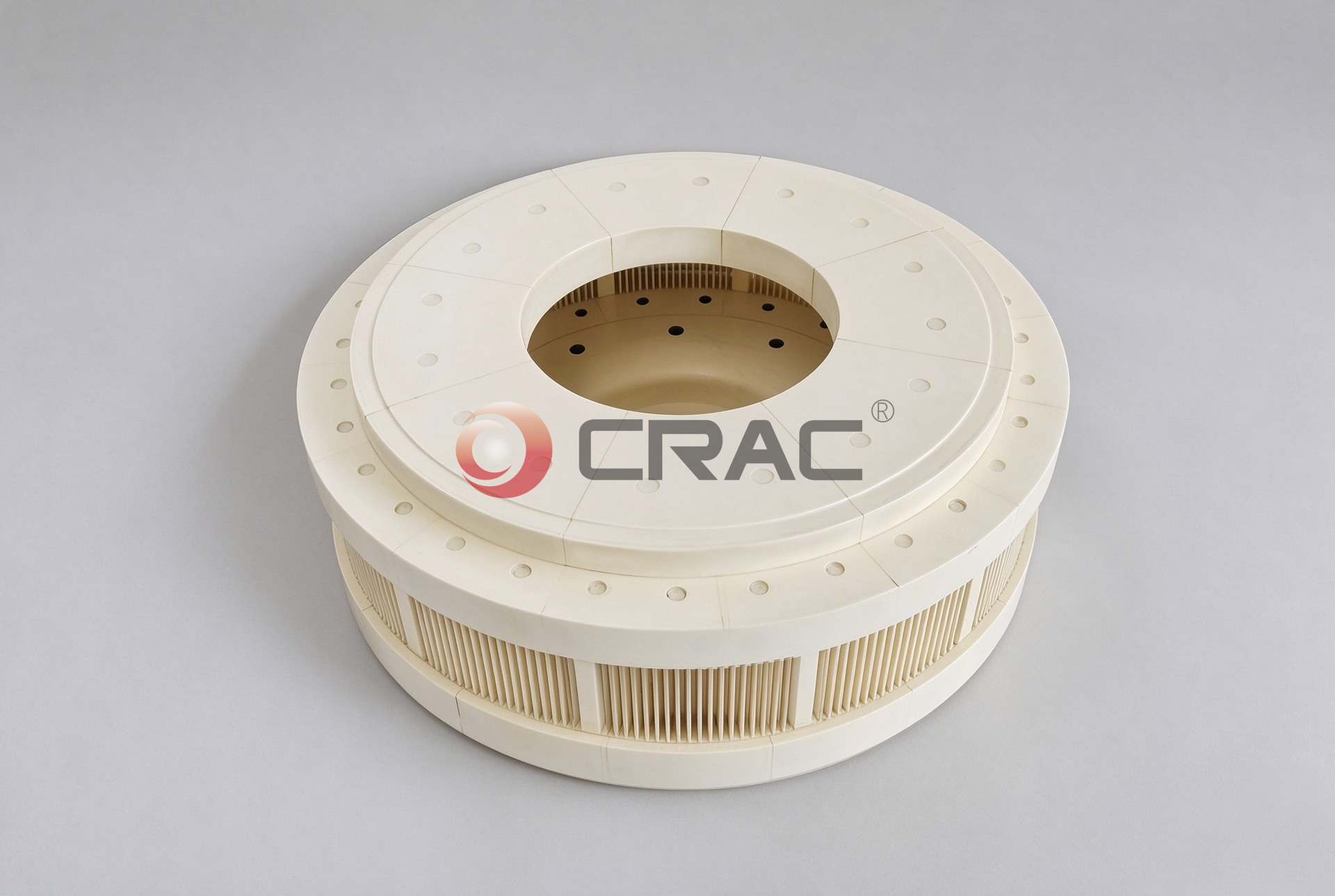
A classifier wheel is a thin-walled, bladed rotor — exactly the kind of complex geometry that is hard to machine. CRAC forms it by ceramic injection molding, reproducing the full blade array and hub in one net-shape step, then sintering. Because the blade gaps are molded, their width and positional accuracy are set by the tool rather than by cutting, which is what lets the cut point stay consistent. The manufacturing process for bead-mill ceramic parts follows the same logic of net-shape precision.
Performance You Can Specify
- Cut-point stability – non-wearing blades keep the separation size constant over long runs.
- Narrow top-size – clean blade gaps produce a tight product size distribution.
- Throughput – diameter and speed set how much powder the wheel can classify.
- Purity – no metallic wear debris in the product.
- Low adhesion – the smooth ceramic surface resists powder build-up on the blades.
Applications
- Battery materials – cathode and anode powders demand a stable cut and zero metal pick-up; see high-purity zirconia components.
- Minerals and pigments – abrasive feeds that erode metal wheels quickly.
- Chemicals and ceramics – corrosive or high-purity intermediates.
- Pharmaceuticals and food – contamination-free, cleanable classification.
How to Specify a Classifier Wheel
- Define the cut point – the target top size sets blade gap and speed.
- Set the diameter and blade count – these set throughput and the achievable cut.
- Match the powder – choose the grade for abrasiveness and chemistry.
- Specify balance – state the dynamic-balance tolerance for the speed.
- Confirm the hub interface – match the shaft and seal of the classifier.
Quality and Customization
Wheels are judged at the blade gap and the balance, so CRAC inspects gap uniformity and dynamic balance before release. Custom blade profiles and sizes are feasible because the part is net-shaped by injection molding; the OEM/ODM program supports development from a drawing. In a grinding circuit the wheel works alongside ceramic grinding discs and other bead-mill ceramic parts to keep the line metal-free. See how zirconia structural parts perform under extreme wear.
Frequently Asked Questions
Can a ceramic wheel replace a steel one directly?
Yes, provided diameter, blade count and hub interface match the existing classifier; the ceramic version then extends life and removes metallic contamination.
What makes the cut point drift on a metal wheel?
Abrasive powder erodes the blade edges, widening the gaps; the separation size coarsens and the product distribution broadens until the wheel is replaced.
Which grade for abrasive battery powders?
Zirconia for the longest edge life and the most stable cut; ZTA where a cost-balanced profile is acceptable.
Is a custom blade profile possible?
Yes — blade count, gap and hub can be tailored to the classifier through net-shape molding.
Need a classifier wheel matched to your cut point and speed?