A ceramic filter does not work like a mesh that catches particles on its surface. It is a monolithic, porous ceramic body in which a continuous, tortuous network of pores runs all the way through. Fluid passes through that internal path while suspended solids, droplets or bubbles are retained by a combination of sieving, inertial impaction and depth capture. The result is a filter whose retention is set by pore geometry rather than by a fragile surface layer — which is why ceramic filters stay effective long after a woven or punched screen would have bled through. CRAC produces these porous bodies by advanced ceramic injection molding, controlling both the shape and the pore structure in a single net-shape step. See the CRAC ceramic filters product page for the current range.
How Retention Is Actually Set
Two independent parameters decide whether a ceramic filter does its job: mean pore size and porosity. Mean pore size sets the cut point — particles larger than the pore mouth are stopped, smaller ones pass. Porosity (the volume fraction occupied by pores, typically 30–50% in these grades) sets how easily fluid moves: higher porosity means more open area and lower pressure drop, but also a weaker, more brittle skeleton. Good filter design is the negotiation between those two. A filter tuned for fine clarification has small pores and tight retention; one tuned for high-throughput pre-filtration has larger pores and more open area. CRAC grades both independently so the two can be matched to the duty.
Building a Pore Structure You Can Rely On
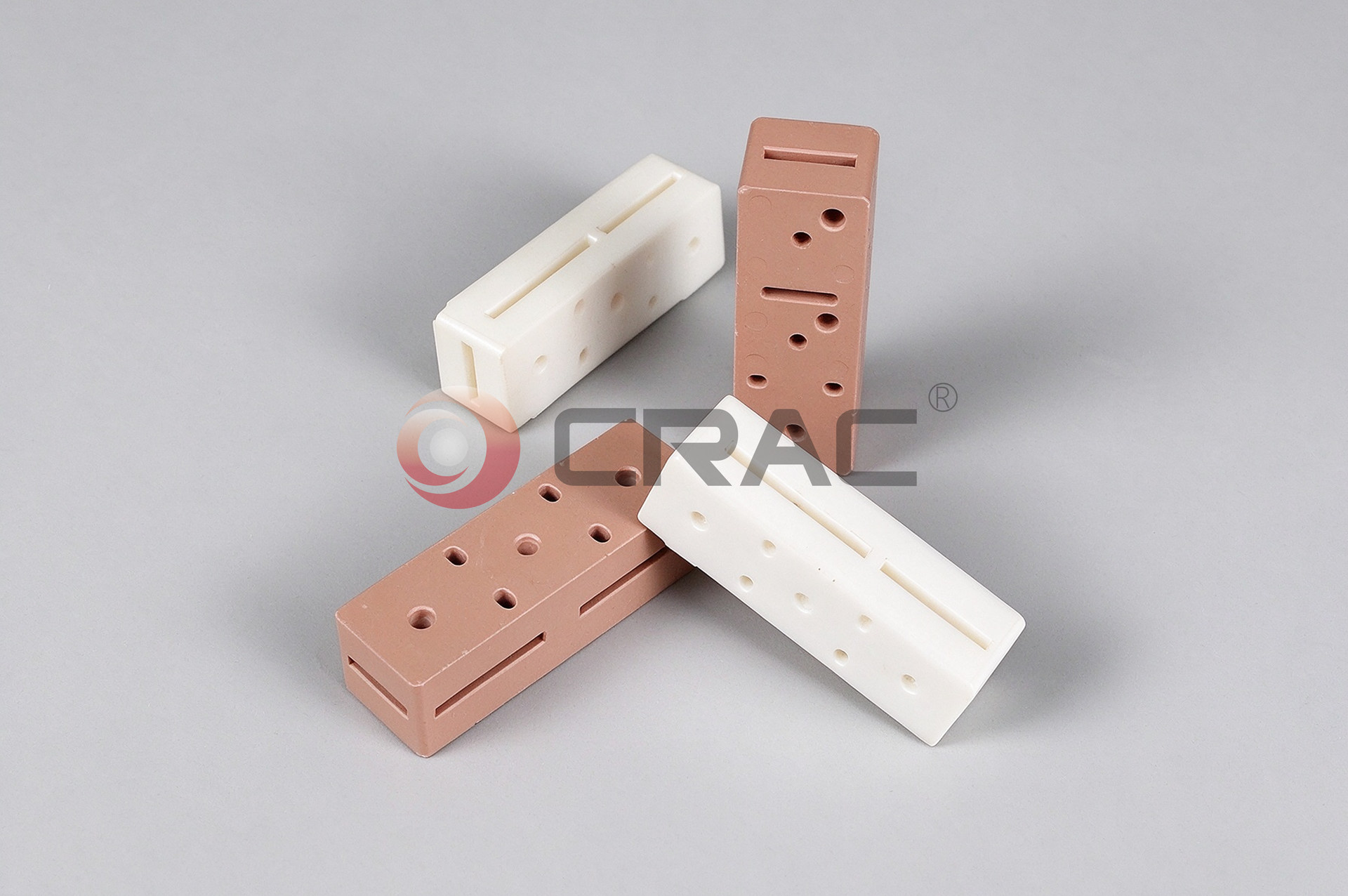
Unlike a solid ceramic part, a filter has to keep its pores open and connected through sintering. CRAC mixes the ceramic powder with a binder and a controlled pore-forming agent, then injection-molds the green body in its final shape. During debinding the binder and pore former burn out, leaving a continuous void network; sintering then bonds the ceramic skeleton without closing the pores. Because the pores are generated during this burn-out rather than by drilling or etching after the fact, an asymmetric or gradient structure (coarse support layer, fine retention layer) can be built into the same part. That is the key advantage of net-shape porous molding over machining a solid blank.
Choosing the Material by What You Filter
The fluid, not the filter shape, usually drives the material choice. The table below summarises the family-level behaviour of the grades CRAC offers for filtration.
| Property |
Alumina |
Zirconia (Y-TZP) |
ZTA blend |
| Typical porosity | 30–50% | 30–45% | 30–48% |
| Mean pore size range | 1–100 µm | 1–80 µm | 1–90 µm |
| Max service temperature | ~1000–1200 °C | ~600–800 °C | ~900–1100 °C |
| Acid / alkali resistance | Excellent (avoid HF, hot caustic) | Excellent | Excellent |
| Best at | High-temp, broad chemical duty | Toughness, impact, thermal shock | Balanced cost + strength |
Pore size and porosity are tuned per grade, so the practical choice is driven by temperature and chemistry first, then by the required cut point. Our material classification guide and zirconia selection guide cover the trade-offs in more detail.
Manufacturing a Porous Net-Shape Body
A filter cannot be made the way a solid rotor or nozzle is made, because any machining after sintering would smear ceramic across the pore mouths and seal them. CRAC instead forms the whole porous component — shape and pore network together — by precision ceramic injection molding. Fine powder, binder and pore former are compounded, injected into the final geometry, debound and sintered in one controlled cycle. The CIM process guide explains the steps; because the pores are created during burn-out, the open structure survives intact. For bespoke grades or shapes, the OEM/ODM program develops custom pore structures from a drawing or a duty specification.
Performance Values Worth Specifying
- Permeability at a given ΔP – defines flow capacity; set by porosity and pore size.
- Dirt-holding capacity – depth capture lets the body hold far more solids than a surface screen of equal area.
- Cleanability – many grades survive backflush or ultrasonic cleaning, restoring flow without replacing the element.
- Mechanical load – the porous skeleton still has to survive assembly pressure and thermal cycling.
- Thermal shock – zirconia grades resist sudden temperature swings that would crack alumina.
Filter Forms and Where They Fit
The same porous ceramic is finished as different geometries: candles and tubes for cartridge housings, flat discs for inline or vacuum filtration, plates for diaphragm and aeration duty, and cones or caps for specialised fittings. The form follows the housing, not the other way round.
Applications by Duty
- Polymer and resin clarification – removing gel and particulate before extrusion or casting.
- Gas sparging and diffusion – producing fine, uniform bubbles for aeration or reaction.
- Bioreactor and medical streams – biocompatible, cleanable media; see medical ceramic micro-components and micron-tolerance medical ceramic parts.
- Aggressive liquid filtration – acids, alkalis and solvents that attack metal screens.
- High-purity processing – high-purity zirconia components keep sensitive streams free of metallic pick-up.
How to Size a Ceramic Filter
- Fix the cut point – choose mean pore size at or below the particle size you must retain.
- Set the flow – match porosity and area to the required throughput at an acceptable pressure drop.
- Confirm the environment – verify temperature, chemical and thermal-shock limits for the grade.
- Pick the form – candle, disc, plate or cone to suit the housing.
- Define cleanability – specify backflush or ultrasonic cleaning if the element must be reused.
Quality and Customization
Pore integrity is verified, not assumed. CRAC uses bubble-point and permeability checks to confirm the pore structure batch to batch, alongside dimensional inspection of the outer shape. Pore grade, porosity, shape and any asymmetric layer can all be customized to a duty.
Frequently Asked Questions
Can ceramic filters be cleaned and reused?
Many grades are designed for backflush or ultrasonic cleaning, which restores flow by clearing captured solids from the pore network rather than replacing the element.
Does smaller pore size always mean better filtration?
Not by itself. Smaller pores give finer retention but raise pressure drop and lower throughput, so the right size is the coarsest that still meets the cut point.
Will they survive aggressive chemicals?
Oxide ceramics resist most acids, alkalis and solvents; the main exceptions are hydrofluoric acid and hot concentrated caustics, which should be checked against the specific grade.
Can pore size and porosity be specified independently?
Yes — CRAC controls both during formulation, so retention and flow can be tuned separately to the application.
Need a ceramic filter matched to your cut point and flow?