In a bead or sand mill the grinding disc is the part that actually does the work: it grabs the grinding media in its profile and flings it against the product, and the energy of those bead impacts is what breaks particles down and disperses them. So a disc is not really a "plate" — it is an energy-transfer element, and its geometry, balance and wear behaviour decide how much milling power reaches the product and how clean the result stays. CRAC makes these discs in oxide ceramics so they survive the continuous bead-stream abrasion without shedding metal into the slurry. See the range on the CRAC ceramic grinding discs product page.
How a Disc Drives Milling
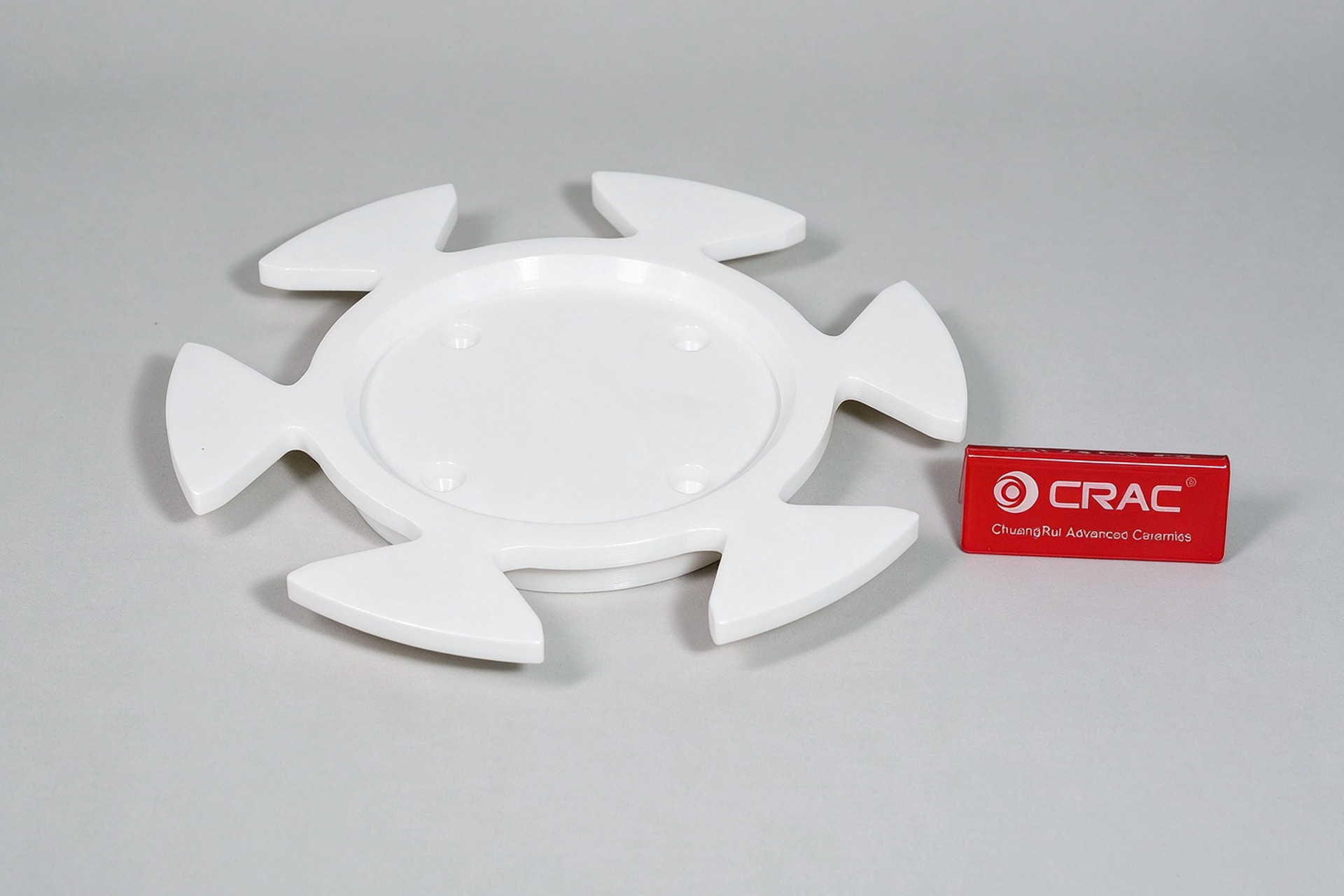
The disc accelerates the bead bed by dragging it through the chamber; the peripheral speed (tip speed) is the single biggest lever on milling intensity. The profile — whether the disc is a smooth rotor, a toothed wheel or a pin-style agitator — sets how aggressively the beads are sheared and how the product is conveyed. More, shallower teeth raise power density; fewer, deeper features move more volume. The disc also has to keep the beads from packing and the product from short-circuiting the chamber, so profile and chamber design are matched, not chosen independently.
Where Discs Actually Fail
Two failure modes dominate. The first is peripheral wear: the outer edge of the disc sees the highest bead velocity, so it erodes fastest; as the edge rounds off, tip speed at the working radius drops and milling efficiency falls. The second is imbalance: any asymmetry grows into vibration at thousands of rpm, which limits speed and shortens bearing life. A ceramic disc addresses both — the edge stays dimensionally stable far longer than steel, and net-shape molding holds the balance features accurately.
Materials by Speed and Slurry
The grade is chosen for edge wear and the chemistry of the slurry. Family-level behaviour:
| Property |
Alumina |
Zirconia (Y-TZP) |
ZTA blend |
| Peripheral wear | Good | Very good | Good |
| Bending strength | ≥600 MPa | ≥1000 MPa | ≥800 MPa |
| Contamination risk | None (non-metallic) | None (non-metallic) | None (non-metallic) |
| Best at | Cost-sensitive general duty | Longest edge life, high speed | Balanced wear + cost |
Our material classification guide and zirconia selection guide cover the grade trade-offs in more depth.
Molding the Profile and Balance
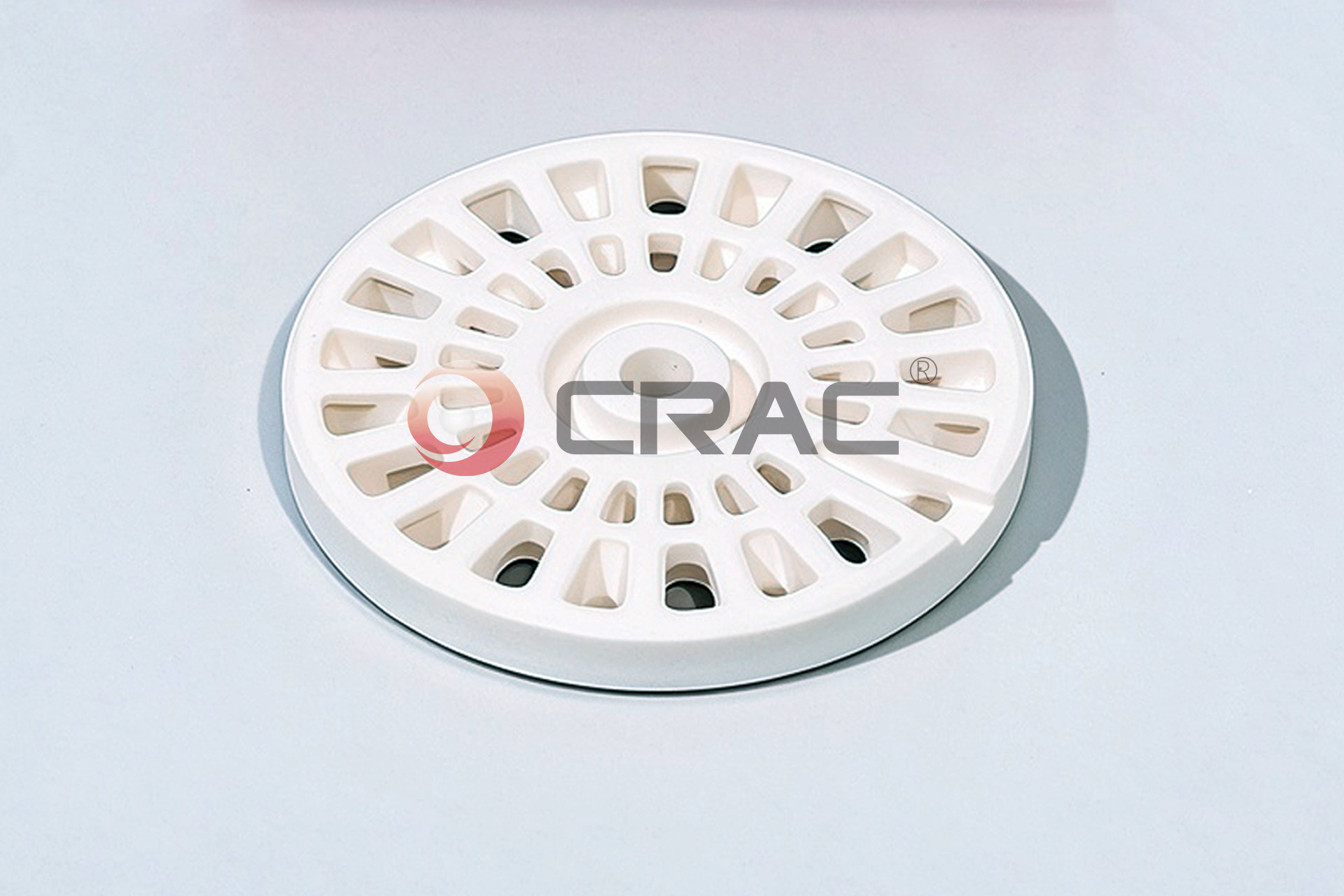
A disc's teeth, slots and counterbalance features are too precise to machine economically at volume. CRAC forms them by precision ceramic injection molding, producing the full profile — including balance features — in one net-shape step, then sintering. The CIM process guide explains the steps; because the geometry is molded, symmetry and balance are controlled by the tool rather than by post-machining. For a non-standard mill the OEM/ODM program develops a custom profile from the chamber drawing.
Performance You Can Specify
- Tip speed capability – a stable ceramic edge lets the mill run at higher peripheral speed without rapid wear.
- Power transfer – profile geometry sets how much energy reaches the bead bed.
- Particle-size distribution – consistent geometry keeps the final PSD repeatable batch to batch.
- Purity – non-metallic surfaces add no iron or chrome to the product.
- Wear life – a slow-eroding edge holds efficiency longer than steel.
Disc, Pin or Turbine
- Disc rotors – broad energy input, good for general fine grinding and dispersion.
- Pin agitators – high shear, suited to disagglomeration and very fine products.
- Turbine / ring types – controlled conveying and narrow residence time.
Applications
- Coatings, inks and pigments – fine, contamination-free dispersion for consistent colour and finish.
- Battery-material slurry – clean milling of cathode and anode slurries where metal pick-up is unacceptable; see high-purity zirconia components.
- Mineral and ceramic processing – abrasive feeds where metal discs wear quickly.
- Pharmaceutical and food – inert, pure processing of sensitive materials.
How to Specify a Grinding Disc
- Match the mill – disc type, diameter and shaft interface to the chamber.
- Pick the profile – disc, pin or turbine per the target fineness and throughput.
- Choose the bead size – disc gap and feature size must suit the grinding media.
- Set the grade – zirconia for longest edge life, ZTA or alumina where cost-balanced.
- Confirm balance spec – state the required dynamic balance for the speed.
Quality and Customization
Discs are judged at the edge and the balance, so CRAC checks geometry and balance directly and verifies the sintered profile against the drawing. Profile, material and size can be tailored to a specific mill; related bead-mill ceramic parts and ceramic dispersion discs are covered separately. See how zirconia structural parts perform under extreme wear.
Frequently Asked Questions
Do ceramic discs avoid slurry contamination?
Yes — the non-metallic, inert surface does not shed iron or chrome, which is why they are used for battery slurries and pigments where any metallic contamination is a defect.
Why does disc profile matter more than material?
Profile sets how the beads are accelerated and sheared, which drives milling intensity; material mainly decides how long the profile survives at the working speed.
Can a disc be balanced for high speed?
Yes — balance features are molded into the part and verified, so the disc runs true at the mill's rated rpm.
Is a custom profile possible?
Yes — diameter, tooth geometry and mounting are set by the tool and can be developed for a specific chamber.
Need a grinding disc matched to your mill and bead size?