A molder can quote a ceramic medical component in a day and still lose the order three weeks later, at the documentation stage. The part is right, the price is right, and then the quality engineer asks for the furnace record and the change-control agreement, and the conversation stops. Suppliers who have never been through a medical audit tend to assume the gate is the material; in practice the material is the easy part, because it is printed on a certificate. The gate is whether every claim on that certificate can be traced back to a record.
What follows is the document set a ceramic medical part should arrive with, written from the side of the table where the auditor sits — what each item proves, and where suppliers commonly overstate what they can provide.
Question One Is Never the Price — It Is the Identity of the Lot
Before anyone discusses dimensions, an auditor wants to know what the part is made of, in the language of a standard rather than a catalogue. "Zirconia" is not an answer. The useful answer names the grade, the stabiliser and the measured properties for the lot that the parts came from: zirconia content, density, bending strength, hardness, and the test methods behind each figure.
For reference, the two grades most often specified for medical and orthodontic work sit at opposite ends of a trade-off. Alumina at 99.7 percent purity reaches a density above 3.9 g/cm3 and roughly 2000 HV, with bending strength around 600 MPa — hard, inert, dimensionally stable, and free of the ageing behaviour described below. White 3Y zirconia reaches a density near 6.0 g/cm3 and bending strength above 1000 MPa at about 1200 HV — less hard, far stronger, which is what allows a thin section to survive. The full family, including the zirconia toughened aluminas, is set out in the material classification guide and compared grade by grade in the A-ZR, 3Y and yellow zirconia selection guide.
What the auditor is checking is not the number but the link: does the density on the certificate correspond to a specific furnace run, and does that run correspond to the parts in the box?
Biocompatibility: Two Different Claims That Get Blended Together
There are two statements in this area and they are not interchangeable. The first is a material statement: the ceramic is chemically inert, non-oxidising, does not release metal ions in contact with tissue, and does not support bacterial growth. That is a property of the material and a molder can support it with composition data and literature.
The second is a device statement: this finished component has passed a biological evaluation to ISO 10993, with cytotoxicity, sensitisation and irritation testing on the final article in its final state. That testing belongs to a device, and the responsibility for it sits with whoever registers the device — usually the customer, not the component supplier. A molder claiming the second when they can only support the first is the single most common overstatement in this category, and it is the one an auditor will unpick first.
The productive way to divide it: ask the molder for composition, leachables-relevant chemistry and process contamination controls, and take responsibility for the biological evaluation of the finished device, using the component data as input. Where the part has to be qualified as a device component, the micron-tolerance moulding route used for medical device components is the relevant capability.
Sterilisation: One Real Risk, and It Is Not the One People Expect
Ceramic survives the usual sterilisation routes comfortably — moist heat, dry heat, ethylene oxide, gamma and hydrogen peroxide plasma all leave an oxide ceramic chemically unchanged, and it tolerates far higher temperatures than the polymer housings around it. That is the good news, and it is where most supplier conversations stop.
The risk worth raising concerns zirconia under repeated moist heat. Yttria-stabilised zirconia can undergo a slow, low-temperature transformation at the surface when exposed to water or steam over time — the tetragonal phase converts to monoclinic, with a volume change that roughens the surface and can initiate microcracks. This is a well-characterised ageing mechanism, and ISO 13356 addresses it with an accelerated steam ageing test precisely because it matters. Single autoclave cycles are not the concern; dozens or hundreds of them, on a reusable instrument, are.
Alumina does not have this behaviour, which is one reason it retains a place in reusable and load-bearing medical parts. Where a zirconia part will be repeatedly steam-sterilised, the honest answer is to validate it rather than assume it: state the number of cycles expected, and ask for ageing data or a reuse limit. Setting a defined service life is a legitimate engineering answer; claiming unlimited autoclave cycles without evidence is not.
Cleanability Is a Surface Question, Not a Material One
Dense oxide ceramic has water absorption below 0.05 percent, so it does not harbour residue in the way a porous or roughened material does. That is a genuine advantage and it is usually stated correctly. What is often left unstated is that cleanability depends on the surface the part actually has — as machined, as lapped, or as polished — and on features that trap material: blind holes, sharp internal corners, and any texture left by a coarse grinding pass.
Two specifications do most of the work. Surface roughness at the wetted surfaces, stated as an Ra limit rather than "smooth". And a geometry review for cleanability, done at drawing stage, that removes blind pockets which cannot be flushed. If the part will be cleaned in a validated washer-disinfector cycle, say so in the enquiry, because it constrains both the finish and the geometry.
Traceability: One Number That Has to Survive the Whole Route
The traceability requirement is simple to state and hard to satisfy: from a part in a box, back through the grinding lot, the moulding lot, the furnace run, to the powder lot. Ceramic processing makes this harder than metal, because parts lose their individual identity at sintering — they go into a furnace as a batch and come out as a batch, and every part in that run shares a thermal history whether or not it shares a mould cavity.
Practical traceability therefore rests on batch discipline: furnace run records with the actual temperature profile, cavity identification where a multi-cavity tool is used, and a lot number that links all of it. Ask to see one worked example — pick a lot number and walk it backwards. A supplier who can do that in ten minutes has a system; one who needs to call someone does not.
Dimensions and Finish: What to Actually Write on the Drawing
Medical micro-parts are usually specified tighter than industrial parts, but the useful specification is not "as tight as possible". It is a set of tolerances that can be inspected, on features that matter. Three rules avoid most of the arguments later:
Nominate the datum. For any concentricity or position callout, say which feature is the reference and at what axial position it is measured.
Separate size from form. A diameter tolerance does not control roundness or taper; if those matter, call them out.
Put the finish where it functions. An Ra limit on a sealing face is a requirement; the same limit on a non-functional surface is cost with no benefit.
Injection moulding supports complex three-dimensional geometry in one piece at micron-level tolerance, which is why small medical and orthodontic parts are usually moulded rather than pressed and machined — the route is described under precision ceramic injection moulding. Micro-parts of this class are catalogued on the medical ceramic micro-components page.
Colour, Appearance and the Cosmetic Dental Case
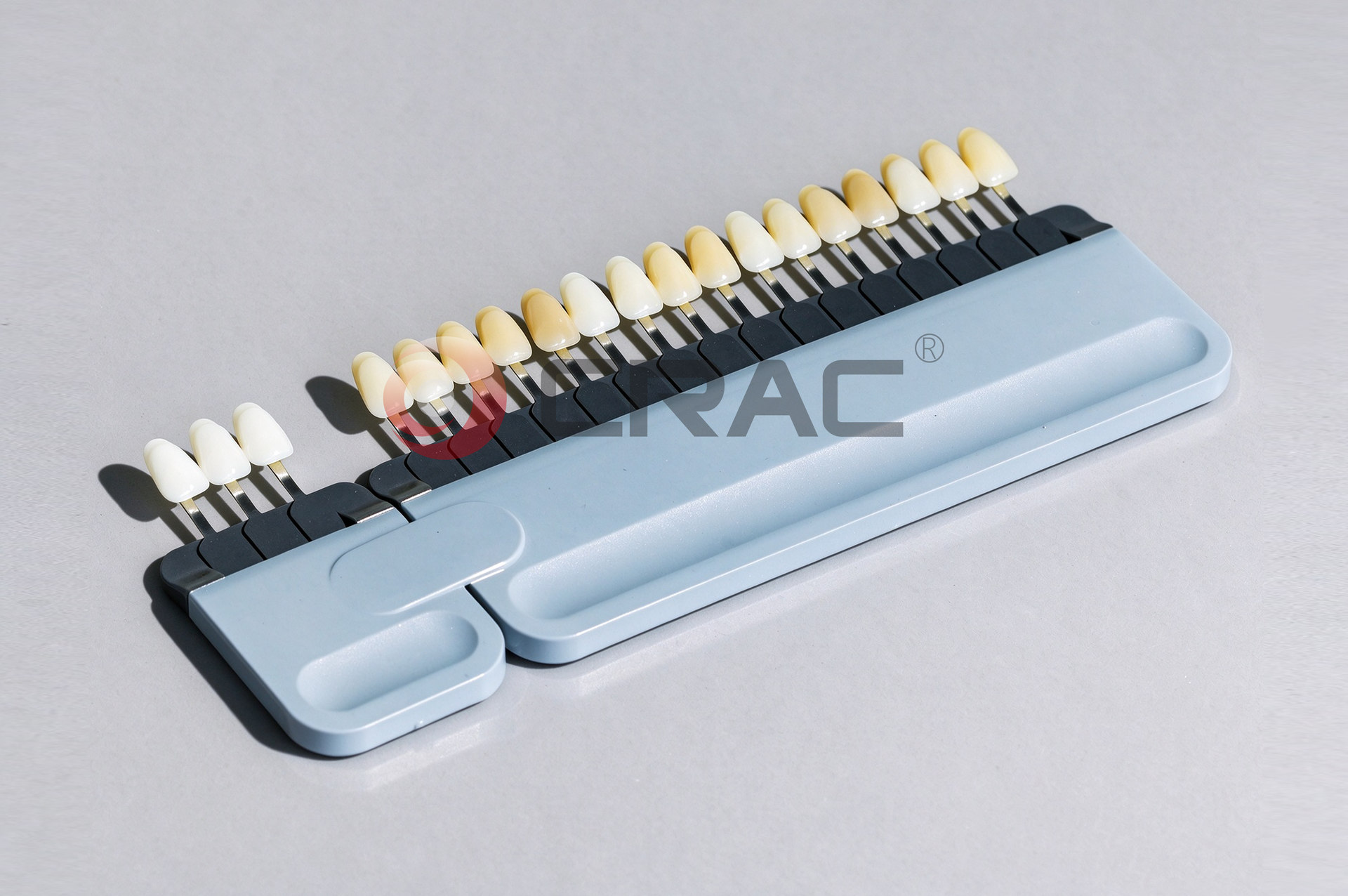
Where the part is visible — a tooth shell, an orthodontic bracket, a cosmetic component — colour becomes a specification rather than an afterthought. Three things belong on the drawing or the purchase order: the target shade and the acceptable difference, whether the colour must be through-body or may be a surface effect, and whether the part will be inspected under a specified light source. Zirconia is available in an ivory-white and a black grade, and the coloured variants include a pink zirconia-toughened ruby; the choice is a material decision with a cosmetic consequence, so it should be made once and recorded, not adjusted lot by lot.
Lot-to-lot colour drift is almost always a raw-material or firing difference rather than a moulding one, which is another reason the furnace record matters.
The Document Package, Item by Item
| Document |
What it actually proves |
Who can issue it |
| Material certificate | Grade, composition, measured density and strength for the lot | Component molder |
| Material safety and composition statement | What is in it, and that nothing prohibited was added | Component molder |
| Biological evaluation report | ISO 10993 testing on the final article | Device registrant, not the molder |
| Sterilisation compatibility statement | Which routes the part tolerates, and any cycle limit | Molder for material; device maker for validation |
| Cleaning and residue data | Surface finish achieved, and process residues controlled | Component molder |
| Dimensional inspection report | Measured values against the drawing, with method named | Component molder |
| Process and furnace records | The thermal history behind the lot, for change investigation | Component molder |
| Change-control agreement | Notification before any change in material, tool, or process | Both parties, signed |
The last row is the one buyers forget to ask for and the one that causes the worst surprises. A silent change in powder supplier, mould cavity or furnace loading can shift colour, density or shrinkage without changing a single dimension on the incoming report — until a lot behaves differently in assembly.
Where a Drawing-Based Supplier Fits
For parts outside a standard range — a shaped orthodontic component, a micro insert with a bore through it, a ceramic element that replaces a metal one in an existing instrument — the work starts from a drawing rather than a catalogue, through the OEM and ODM programme and the custom zirconia structural parts capability. The same moulding platform produces the sleeves and ferrules used in optical connectors, where sub-micron concentricity is routine — a useful reference point when a medical part needs a bore held to a similar order.
If you are preparing a documentation pack for an audit, send the drawing and the intended sterilisation route. The two together determine which grade is appropriate and which records have to exist, and it is cheaper to settle that before the tool is cut.
Send the drawing and the sterilisation route — we will confirm grade and records.